Goddess Durga and her family: reading the image
 Pujo Parikrama team6 min read · Updated
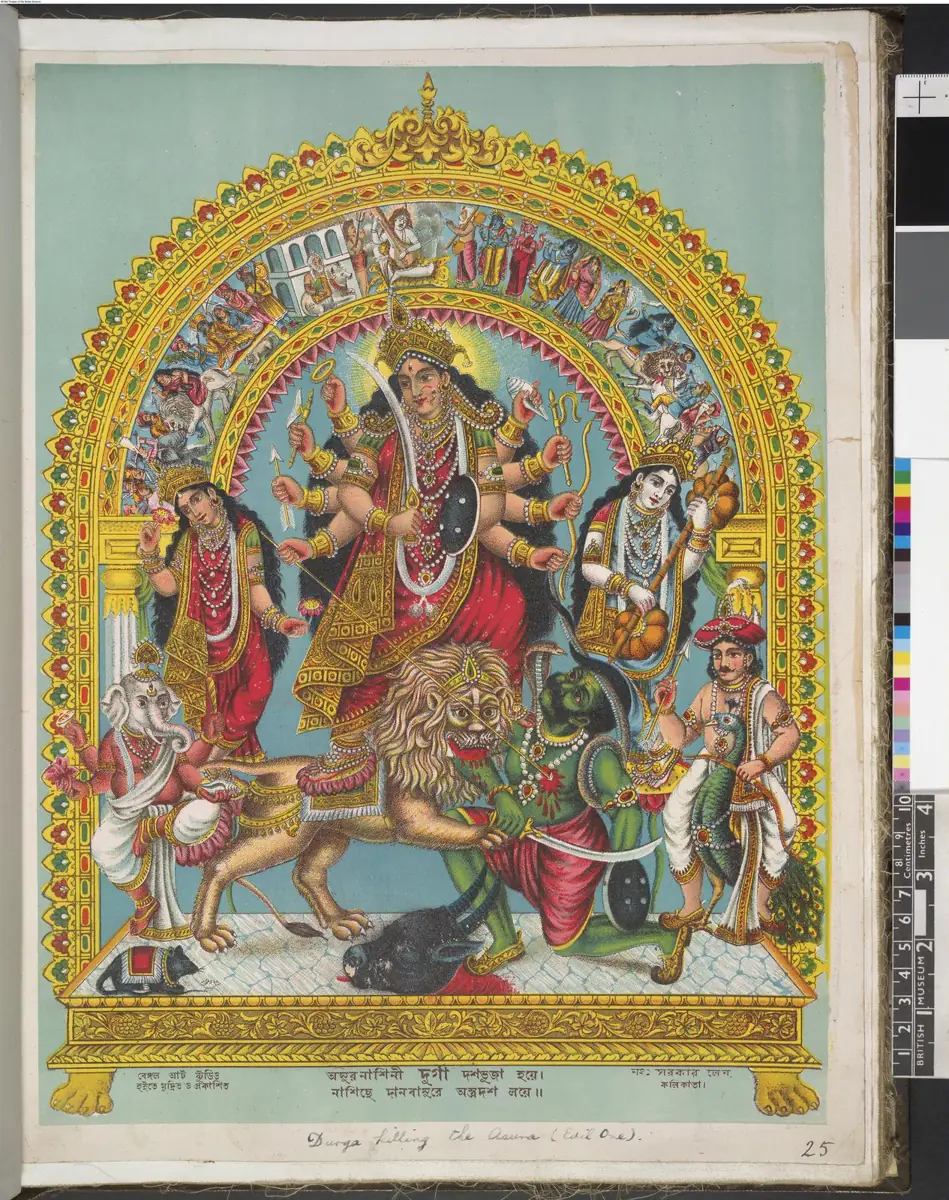
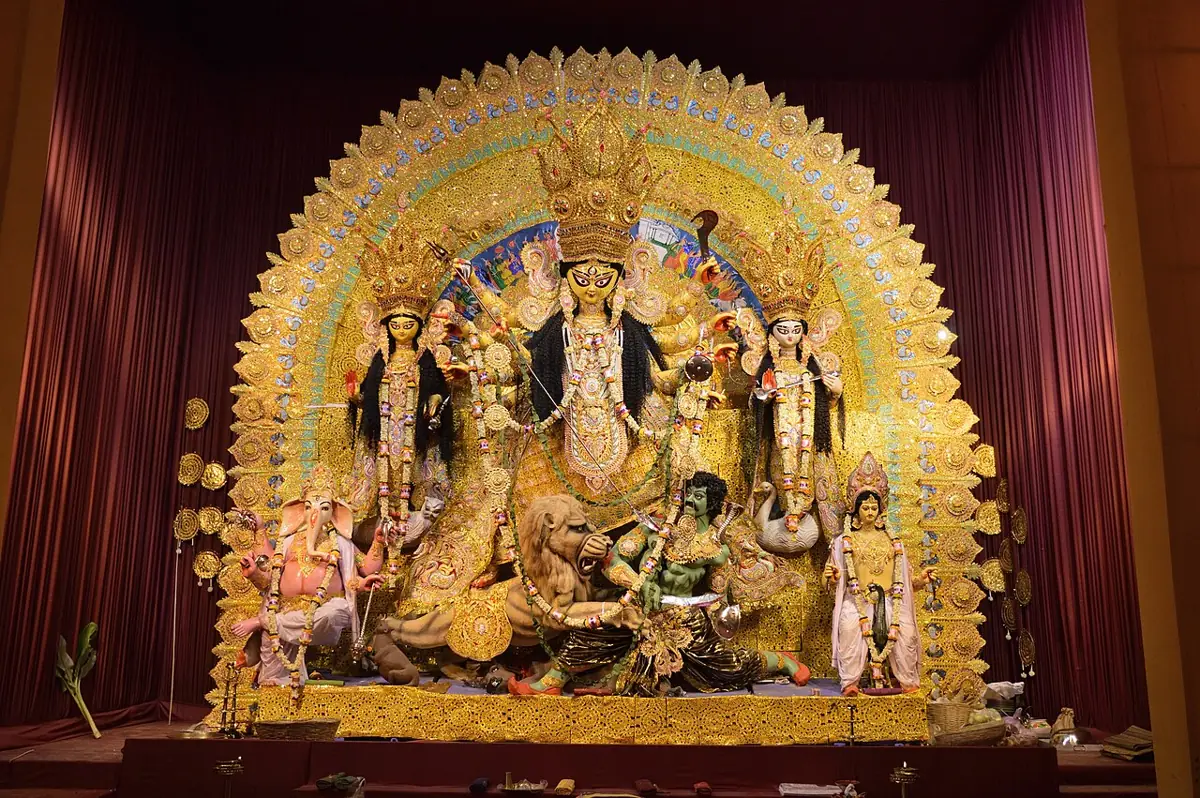
The Bengali Durga Puja image shows the ten-armed goddess Durga on her lion, spearing the demon Mahishasura as he emerges from a buffalo, with her four children beside her: Lakshmi and Ganesha on her right, Saraswati and Kartik on her left, each with an animal mount. Her weapons are traditionally gifts from the gods, such as Shiva's trident and Vishnu's discus. Older pujas often set the whole family under one arched frame, the ekchala, decorated with white shola or silver daker saaj ornaments.
 ▶ Photo story · 10 pagesGoddess Durga and her family: reading the image
In this article 10 sections
A Bengali Durga Puja image is a whole story in clay. At the centre stands Durga, ten-armed and calm-faced, one foot on her lion and the other on the demon Mahishasura, whom she pierces with a trident as he emerges from the body of a buffalo. Around her, on the same platform, stand her four children with their animal mounts. Once you know who is who and why each object is there, every pandal you visit becomes easier to read, whether it is a traditional image in a north Kolkata courtyard or a reimagined sculpture in a theme pandal.
Durga at the centre
Durga's face is usually serene even in battle: her victory is certain, and the calm expresses that her violence protects rather than destroys. In Bengal she is typically golden or yellow-skinned with large, elongated eyes and a third eye on her forehead. She wears a red or richly coloured sari and a tall crown.
The image shows the climax of the story told in the Devi Mahatmya: the moment Mahishasura, having changed form many times during the battle, finally emerges in his demon form from the severed buffalo, and the goddess strikes.
The ten arms and the gifts of the gods
In the Devi Mahatmya the goddess is born from the combined radiance of the gods, and each then gives her a weapon or gift. The associations most commonly cited are:
| Weapon or object | Commonly said to come from |
|---|---|
| Trident (trishul) | Shiva |
| Discus (chakra) | Vishnu |
| Conch (shankha) | Varuna |
| Thunderbolt (vajra) and bell | Indra |
| Spear (shakti) | Agni |
| Bow and quiver of arrows | Vayu, the wind |
| Noose (pasha) | Varuna |
| Sword and shield | Kala, time or death |
| Axe | Vishwakarma, the divine craftsman |
| Lion | Himavat, the Himalaya |
The text also lists further gifts such as a water pot, a rosary, jewels and garlands. Retellings differ on who gave what, and image-makers vary which hand holds which object, so do not expect every image to match this table. In a typical Bengali image the trident in a right hand pierces Mahishasura while the noose in a left hand binds him.
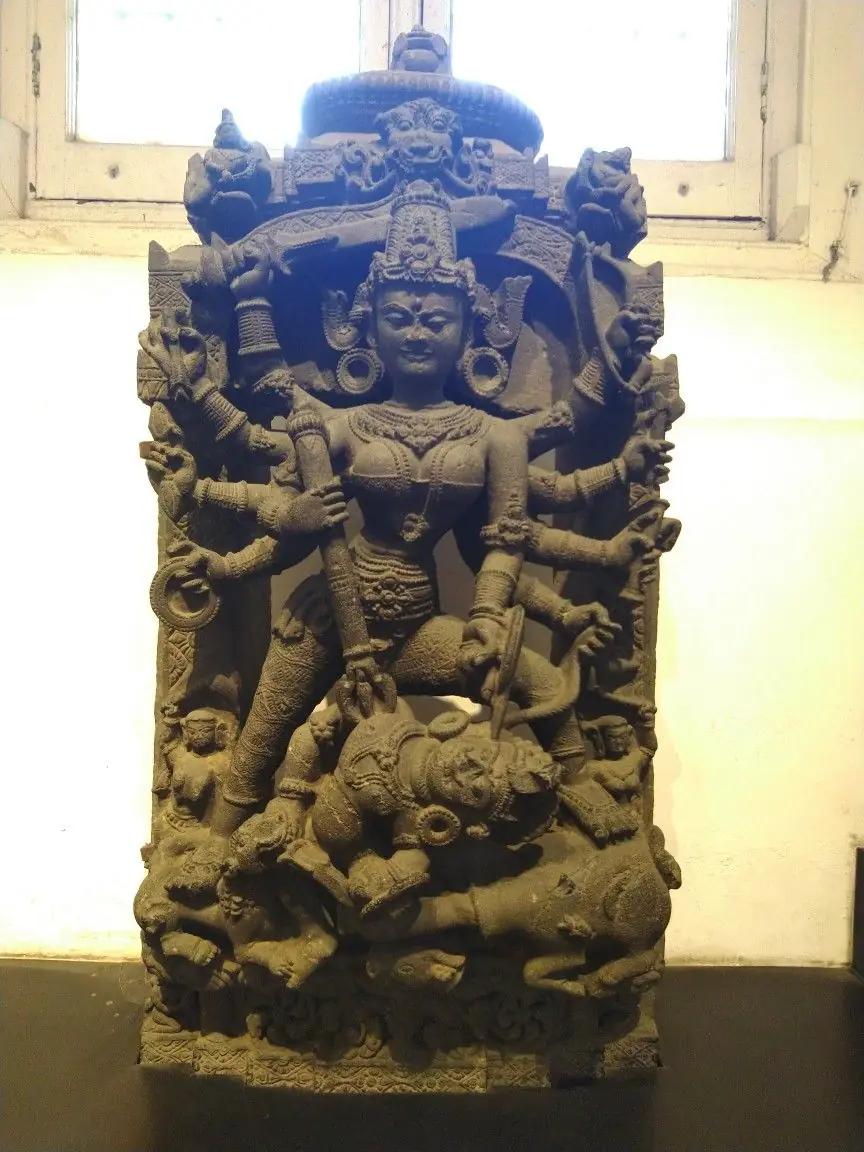
The ten arms themselves are usually read as power reaching in all ten directions. Some traditions show the goddess with eight, eighteen or more arms, and some contemporary theme pandals stylise or simplify them.

The lion
Durga rides a lion (singha), her vahana or mount. In the image it attacks Mahishasura or the buffalo. Older Bengali images sometimes give the lion a distinctive, almost horse-like head, a style seen in some family pujas, while many modern images follow a more naturalistic lion. Some traditions elsewhere in India show a tiger instead.
Mahishasura
Mahishasura is the demon king who drove the gods from heaven. In Bengali images he is muscular, often painted green, with a sword and shield, caught at the moment of defeat, sometimes with a snake held by the goddess binding him. The decapitated buffalo lies beneath. His defeat is read as the conquest of arrogance, ignorance and destructive power.
The family on the dais
The Bengali image is unusual in showing the goddess with her children, because in Bengal she is also Uma visiting her parents' home. Seen from the front, the usual arrangement is:
- Lakshmi, goddess of wealth and prosperity, on Durga's right (your left as you face the image), holding a pot or a lotus. Her mount is the owl (pyancha).
- Ganesha, the elephant-headed remover of obstacles, beside Lakshmi at the outer edge. His mount is the mouse or rat. Next to him stands the Kola Bou.
- Saraswati, goddess of learning and music, on Durga's left (your right), with a veena. Her mount is the white swan (hansa).
- Kartik (Kartikeya), the handsome young god of war, beside Saraswati, with bow and arrow. His mount is the peacock.
Some pujas swap or adjust positions, and a few show Shiva above the goddess, either painted on the backdrop or as a small figure on top of the frame.
 Also readWhat is Durga Puja? The meaning behind the festival
Kola Bou beside Ganesha
The figure in a red-bordered white sari next to Ganesha is the Kola Bou (banana bride). She is a banana plant bound with eight other plants, together called nabapatrika (nine plants), and dressed as a newly married woman. On the morning of Saptami she is taken for a ritual bath in the river or a pond, then installed beside Ganesha. Popularly she is called Ganesha's wife, but many priests and scholars explain her as the goddess herself in plant form, linking the puja to older harvest and fertility worship.

Ekchala: one frame
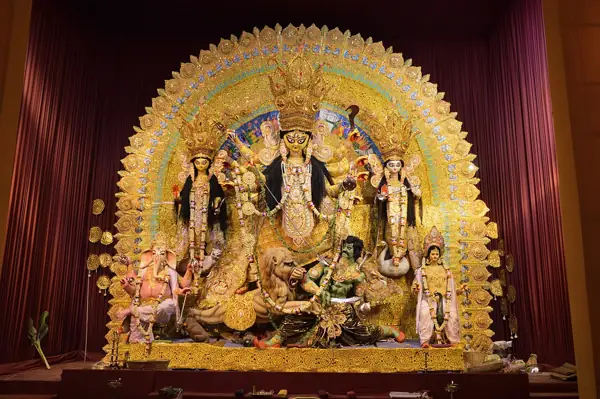
In the ekchala (single frame) style, all the figures, the goddess, her four children, the lion and Mahishasura, are made on one structure and share one semicircular backdrop called the chalchitra. In older pujas the chalchitra is painted with scenes from the lives of the gods, often with Shiva at the top. Ekchala images are typical of bonedi bari pujas and of traditional community pujas such as Bagbazar. Many modern pujas instead give each deity a separate frame and backdrop, which gives image-makers more freedom.
Ornaments: daker saaj and sholar saaj
The jewellery and crowns on traditional images are not metal but made largely from shola, the light, white pith of a marsh plant, carved into crowns, earrings, necklaces and backdrops by specialist craftsmen.
- Sholar saaj (shola ornaments) are the pure white style, delicate and pale against the painted skin.
- Daker saaj is the shimmering style in which ornaments are covered with silvery foil or tinsel. A commonly told story says the foil was once imported and arrived by post (dak), giving the style its name; other explanations exist.
The silver daker saaj with a white sari and red border is the classic look of many traditional north Kolkata images. You can see these crafts being made at Kumartuli.
Chokkhu daan: giving the eyes
The last and most important stage of making an image is chokkhu daan, the gift of eyes, when the artisan paints the goddess's eyes. It is traditionally done on or around Mahalaya, which in 2026 falls on Saturday 10 October. Until the eyes are painted the image is considered unfinished. The image becomes an object of worship only after the rites of the puja itself, when the life of the goddess is invoked on Saptami.
Where to look closely
To compare styles, visit a traditional ekchala image and a theme pandal on the same day. The North Kolkata heritage trail covers Bagbazar, Sovabazar Rajbari and Kumartuli Park; the central Kolkata trail shows how far contemporary artists reinterpret the goddess. For the nine forms of Durga worshipped during Navratri, see Navadurga.
See it in Kolkata
- 📍 Bagbazar SarbojaninOne of the oldest sarbojanin pujas. Traditional daker saaj idol, plus a riverside fair.
- 📍 Sovabazar RajbariA bonedi bari puja started by Raja Nabakrishna Deb. The thakurdalan is stunning.
- 📍 Kumartuli Park SarbojaninNext door to the idol-makers' quarter. Expect bold, artistic themes every year.
Questions people ask
Why does Durga have ten arms?
Her ten arms let her hold the weapons the gods gave her and express that she protects from every direction at once. Devotees read them as a sign of her complete power; some images show eight, eighteen or more arms.
What weapons does Durga hold?
Commonly a trident, discus, sword, bow and arrow, spear, thunderbolt, conch, noose, axe and a shield or bell. Which god gave which weapon, and which hand holds it, varies between texts, regions and image-makers.
Who are the four children with Durga?
In Bengal they are Lakshmi, goddess of prosperity, with her owl; Saraswati, goddess of learning, with her swan; Ganesha, remover of obstacles, with his mouse; and Kartik, god of war, with his peacock.
Who is the woman in a sari next to Ganesha?
That is the Kola Bou, a banana plant bundled with other plants and dressed in a red-bordered sari. She is bathed and installed on Saptami and represents the goddess in plant form; she is often called Ganesha's wife, though many priests explain her as a form of Durga.
What is ekchala?
Ekchala (one frame) is the traditional layout in which Durga, her children, the lion and Mahishasura stand together under a single arched backdrop, the chalchitra, often painted with scenes from mythology.
Read next
- Durga PujaWhat is Durga Puja? The meaning behind the festivalWhat Durga Puja means: the Devi Mahatmya story of Mahishasura, Durga as Shakti, Uma's homecoming, Rama's akal bodhon and why the festival falls in autumn.
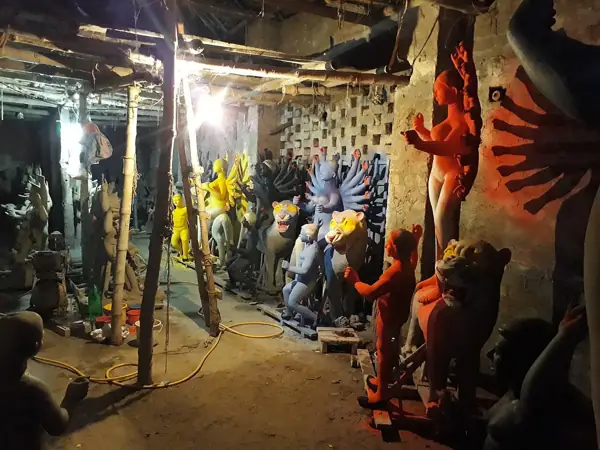 Durga PujaKumartuli and the making of Durga idolsHow Kumartuli's potters make Durga idols: bamboo frame, straw, Ganga clay, punya mati, painting, shola, daker saaj, chokkhu daan on Mahalaya and visiting tips.
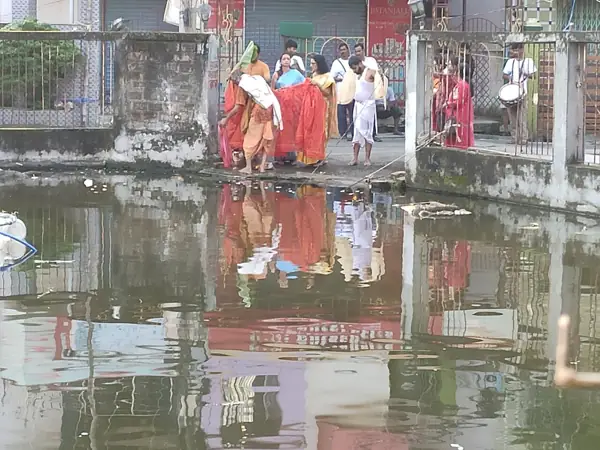 RitualsKola BouKola Bou, or Nabapatrika, is the bundle of nine plants worshipped as Goddess Durga on Saptami. The nine plants, their goddesses and why she stands by Ganesha.
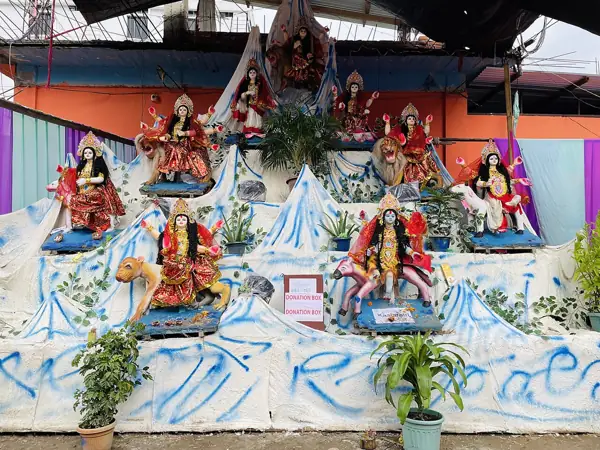 NavratriNavadurgaThe nine forms of Durga, from Shailaputri to Siddhidatri: what each name means, how each is depicted and the offering commonly linked to each Navratri day.