Dasha Mahavidya: the ten wisdom goddesses
 Pujo Parikrama team6 min read · Updated
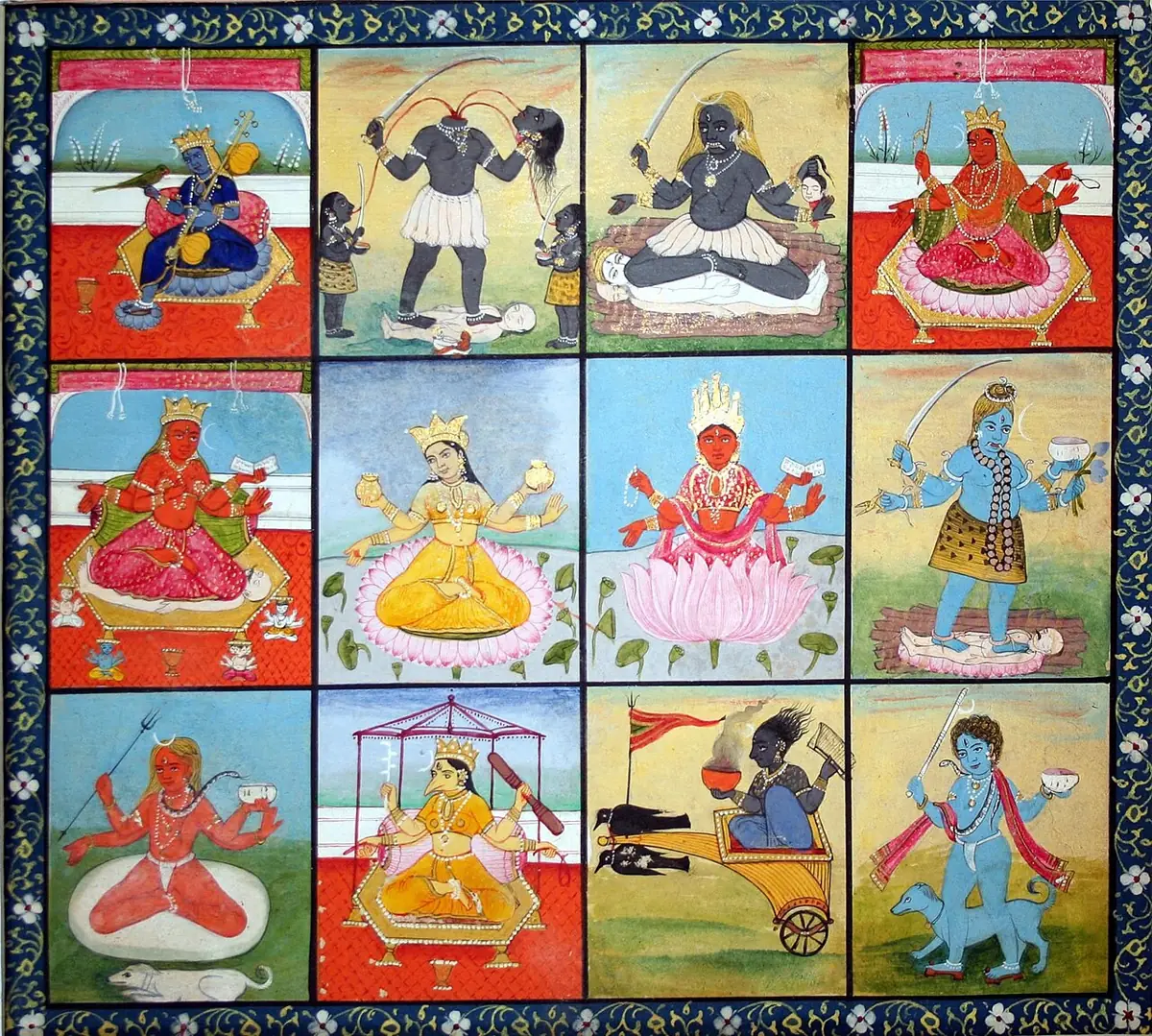
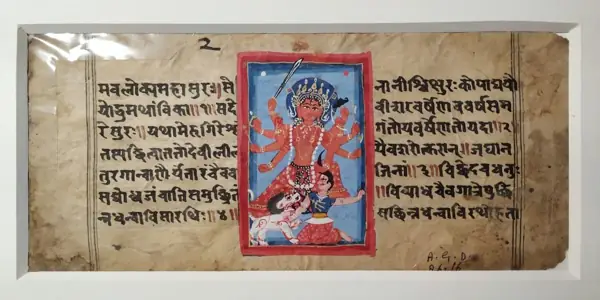
The Dasha Mahavidya are ten forms of the great goddess in Hindu Shakta and Tantric tradition: Kali, Tara, Tripura Sundari (Shodashi), Bhuvaneshwari, Bhairavi, Chhinnamasta, Dhumavati, Bagalamukhi, Matangi and Kamala. Mahavidya means great wisdom, and each form is a way of knowing the one goddess, from the terrifying to the beautiful. Their best-known origin story, told in Bengali Shakta Puranas, has Sati manifest all ten to overawe Shiva; devotees understand them, like Durga, as faces of the same supreme Shakti.
 ▶ Photo story · 7 pagesDasha Mahavidya: the ten wisdom goddesses
In this article 5 sections
The Dasha Mahavidya (dasha, ten; maha-vidya, great wisdom) are ten goddesses of the Shakta and Tantric traditions, each a distinct form of the one great goddess. They range from the terrifying, such as Kali dancing on the cremation ground, to the gentle and radiant, such as Kamala seated on a lotus. Devotees see in them the whole range of the divine mother: creation and destruction, beauty and decay, speech and silence. They are especially important in Bengal and Assam, the heartland of goddess worship, and they share a family resemblance with Durga, whom Shakta devotees understand as another face of the same power.
The ten at a glance
The most common list and order are below. Texts differ slightly, and the descriptions summarise widely shared iconography rather than any single scripture.
| # | Mahavidya | Meaning of name | Typical form |
|---|---|---|---|
| 1 | Kali | the dark one, time | dark, four-armed, garland of heads, standing on Shiva |
| 2 | Tara | she who carries across, the star | blue, holding a skull-cup and scissors or knife, on a funeral pyre |
| 3 | Tripura Sundari (Shodashi) | most beautiful in the three worlds; the sixteen-year-old | radiant, seated on a throne or on Shiva, holding noose, goad, bow and flower arrows |
| 4 | Bhuvaneshwari | queen of the worlds | gentle, bright, holding noose and goad, showing gestures of blessing |
| 5 | Bhairavi | the fierce one | red, with garland of heads, holding rosary and book |
| 6 | Chhinnamasta | she whose head is severed | holds her own severed head, which drinks one of three streams of blood |
| 7 | Dhumavati | the smoky one | an old widow in a horseless chariot, holding a winnowing basket, with a crow |
| 8 | Bagalamukhi | she who paralyses | yellow-clad, holding a demon's tongue and striking him with a club |
| 9 | Matangi | the outcaste one, the Tantric Saraswati | green or dark, playing a veena, with a parrot |
| 10 | Kamala | she of the lotus | Lakshmi on a lotus, bathed by elephants |
The origin story: Sati and Shiva
The best-known account of how the Mahavidyas appeared is told in Shakta texts composed in eastern India, notably the Mahabhagavata Purana and the Brihaddharma Purana.
Sati, daughter of Daksha, has married Shiva against her father's wishes. Daksha holds a great sacrifice and pointedly does not invite his son-in-law. Sati wants to go anyway; Shiva forbids it. Furious at being refused, Sati reveals her true nature. Her form becomes terrifying, and when Shiva tries to flee, she multiplies into ten goddesses who block him in all ten directions. Shiva, overawed, asks who they are, and she names them one by one as her own forms. He lets her go to the sacrifice, where, insulted by her father, she gives up her body. Her death leads to Shiva's grief and, in the wider story, to the Shakti pithas, the sacred sites where parts of her body fell.
The story makes a theological point: the goddess is not subordinate to the god. Shiva may be the great ascetic, but the ten Mahavidyas show that the power behind him is hers.
 Also readGoddess Durga and her family
The ten goddesses
Kali
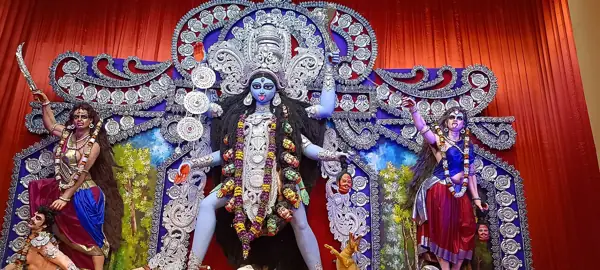
The first and most important Mahavidya, the goddess of time and transformation. Dark-skinned, naked or skirted with severed arms, wearing a garland of heads, tongue out, she stands on the prone body of Shiva. In Bengal she is above all Ma, the mother, and her worship on the new-moon night of Kartik is Kali Puja, coinciding with Diwali. Her great Kolkata temples are Kalighat, one of the most important Shakti pithas, and Dakshineswar, built by Rani Rashmoni in the 19th century and known for Sri Ramakrishna, who served there as priest.
Tara
Tara, the saviour who "carries across" the ocean of suffering, resembles Kali but is usually blue and pot-bellied. She is honoured in Buddhism as well as Hinduism. Her most famous shrine in Bengal is Tarapith in Birbhum district, closely associated with the 19th-century saint Bamakhepa, and a major place of pilgrimage.
Tripura Sundari (Shodashi)
The beautiful goddess of the three worlds, also called Lalita and Shodashi. She is the centre of the Sri Vidya tradition, which worships her through the Sri Yantra.
Bhuvaneshwari
Queen of the universe, the goddess as space itself, in which all the worlds take shape. She is gentle and nurturing in form.
Bhairavi
The fierce goddess, often red-skinned, associated with destruction of what is impure and with ascetic discipline.
Chhinnamasta
Perhaps the most startling image in Hindu art: the goddess who has cut off her own head, which drinks a stream of her blood while two attendants drink the other two. She is read as an image of self-sacrifice, of life feeding life, and of transcending the ego. A well-known temple is at Rajrappa in Jharkhand.
Dhumavati
The widow goddess, old and unadorned, associated with smoke, inauspiciousness, poverty and loss. She teaches that even what we fear and avoid is part of the goddess.
Bagalamukhi
The goddess who stops and paralyses, worshipped for victory over enemies and in disputes. She is associated with the colour yellow.
Matangi
A goddess of speech, music and learning, sometimes called the Tantric Saraswati, linked with those on the margins of society and with offerings of leftover food, overturning ideas of purity.
Kamala
The tenth Mahavidya is a form of Lakshmi, seated on a lotus and bathed by elephants. She stands for prosperity, beauty and good fortune, and closes the circle that begins with Kali.
Their place in Bengal's Shakta tradition
Bengal's devotion to the goddess, Shakta tradition, is visible in its calendar: Durga Puja in autumn, Kali Puja about three weeks later, Jagaddhatri Puja after that, and Basanti Puja in spring. The Mahavidyas run through this tradition. Kali and Tara are worshipped across the region; poets such as Ramprasad Sen sang to Kali as mother (see Agomoni and Bijoya songs); and in Assam the Kamakhya temple complex includes shrines to the Mahavidyas.
Detailed worship of most Mahavidyas belongs to Tantric practice and is traditionally taken up under a teacher's guidance. Ordinary devotees more often know them as images, stories and pilgrimage sites.
How they relate to Durga
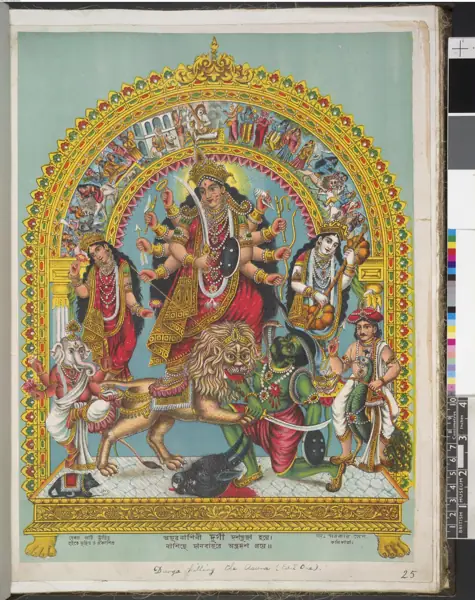
For Shakta devotees, Durga, the Mahavidyas and the Navadurga of Navratri are all forms of one Mahadevi, great goddess. The Devi Mahatmya itself shows the goddess producing other goddesses: in its seventh chapter, Kali springs from her brow to destroy the demons Chanda and Munda. Bengal also identifies Durga with Uma or Parvati, the reborn Sati, so the Sati who manifested the ten Mahavidyas and the Uma who comes home each autumn are understood as the same goddess.
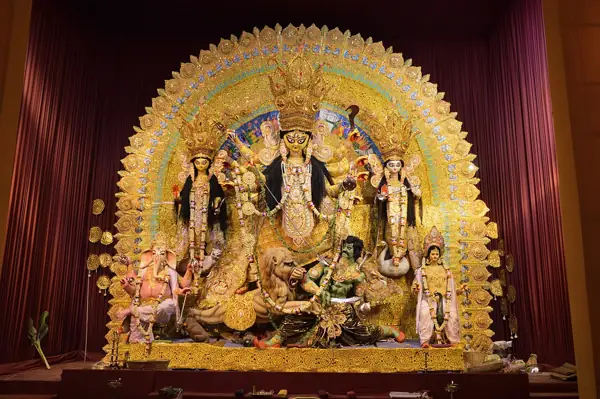
You may see the connection on the pandal itself. The painted arch behind traditional images, the chalchitra, sometimes depicts the ten Mahavidyas alongside scenes of Shiva, and themed pandals occasionally build their whole design around them. Our guide to reading the Durga image explains the rest of what you will see.
Questions people ask
What are the names of the ten Mahavidyas?
In the most common list: Kali, Tara, Tripura Sundari (also called Shodashi or Lalita), Bhuvaneshwari, Bhairavi, Chhinnamasta, Dhumavati, Bagalamukhi, Matangi and Kamala. Some texts give a slightly different list or order.
What does Mahavidya mean?
Mahavidya means great wisdom or great knowledge. Each goddess is understood as a form of wisdom that leads the devotee to realise the one divine mother, and each has her own mantra, image and mode of worship.
How did the ten Mahavidyas originate?
In the best-known story, from Shakta texts such as the Mahabhagavata Purana, Shiva forbids Sati to attend her father Daksha's sacrifice. Angered, she takes on terrifying forms and appears as ten goddesses surrounding Shiva in every direction, until he yields.
Are the Mahavidyas the same as the Navadurga?
No. The Navadurga are nine forms of Durga worshipped on the nine nights of Navratri, from Shailaputri to Siddhidatri. The Mahavidyas are a separate group of ten from the Tantric tradition, though both are understood as forms of the same goddess.
What is the connection between Durga and the Mahavidyas?
Shakta devotees see Durga and the Mahavidyas as forms of one supreme goddess. Kali, the first Mahavidya, also appears in the Devi Mahatmya springing from the goddess's brow in battle, and some Durga Puja backdrops depict the ten Mahavidyas around the image.
Read next
- Durga PujaGoddess Durga and her familyHow to read a Durga Puja image: Durga's ten arms and weapons, the lion, Mahishasura, Lakshmi, Saraswati, Ganesha, Kartik, their vahanas, ekchala and daker saaj.
 FestivalsKali Puja and DiwaliKali Puja in Bengal falls on the new moon of Kartik, with Diwali: Kali's iconography, night-long worship, Dakshineswar, Kalighat, Bhoot Chaturdashi and lamps.
 RitualsChandi PathChandi Path explained: the Durga Saptashati's 700 verses in 13 chapters, its three episodes, Kavacham, Argala and Kilakam, and how to read or listen at home.
 NavratriNavadurgaThe nine forms of Durga, from Shailaputri to Siddhidatri: what each name means, how each is depicted and the offering commonly linked to each Navratri day.
 Durga PujaWhat is Durga Puja? The meaning behind the festivalWhat Durga Puja means: the Devi Mahatmya story of Mahishasura, Durga as Shakti, Uma's homecoming, Rama's akal bodhon and why the festival falls in autumn.