Kanya pujan: how to honour young girls on Ashtami or Navami
 Pujo Parikrama team4 min read · Updated
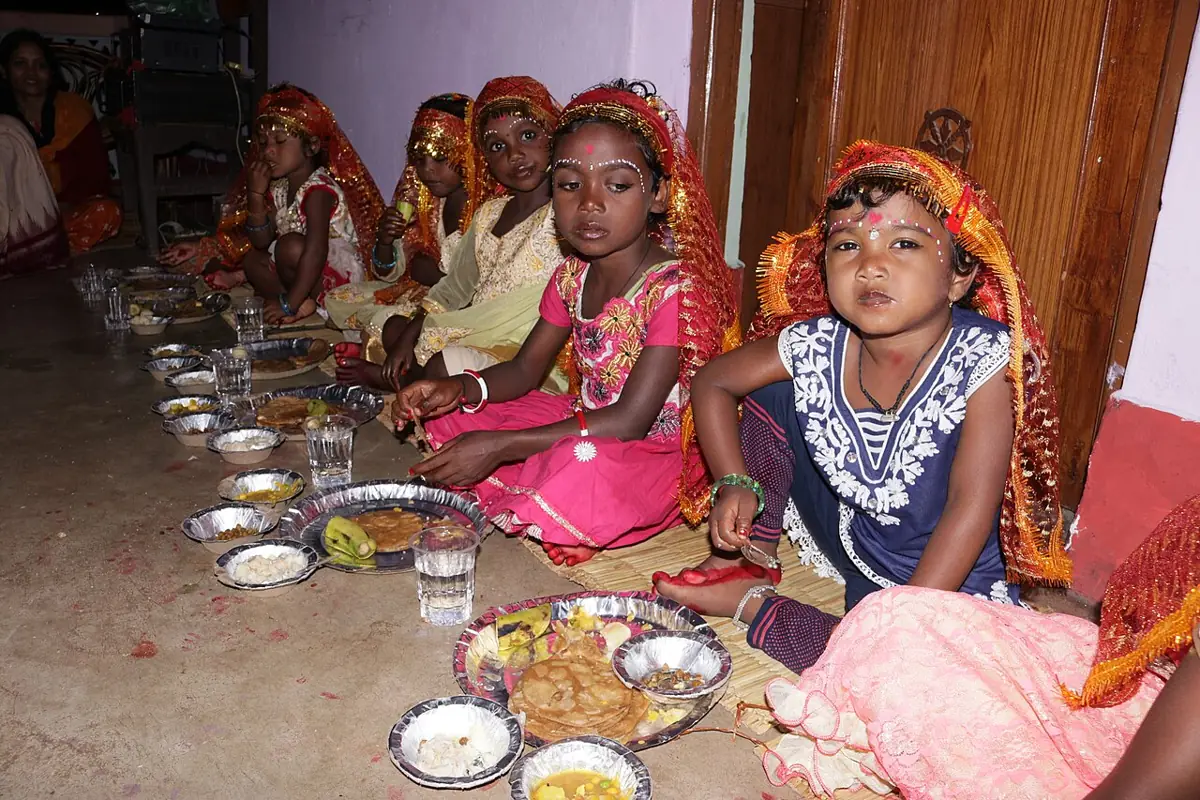
Kanya pujan (also called kanjak or kanjika puja) is a Navratri ritual, done on Ashtami or Navami, in which a family invites young girls, commonly aged about 2 to 10, and often one boy (called langur or Bhairav), honours them as forms of the Goddess by washing their feet, applying tilak and tying a sacred thread, feeds them puri, kala chana and halwa, and gives small gifts. It is especially popular in north India and is related in spirit to Bengal's Kumari Puja. Number, age and the day chosen vary by family.
 ▶ Photo story · 10 pagesKanya pujan: how to honour young girls on Ashtami or Navami
In this article 8 sections
What you need
Step by step
- Choose the day and invite in advance
Decide whether your family observes kanya pujan on Ashtami or Navami, and invite the girls and their parents a day or two ahead. Agree a time so children are not kept waiting hungry.
- Cook the prasad
After bathing, cook puri, kala chana and suji halwa fresh. Offer a portion to the Goddess first, along with the family's own Ashtami or Navami puja.
- Welcome the children
Greet the girls and the boy at the door, seat them comfortably on clean mats, and make sure they are at ease. Ask parents about any allergies or food the children should not have.
- Wash their feet
Gently pour water over each child's feet into a plate and dry them with a clean towel. This act of humility is at the heart of the ritual.
- Apply tilak and tie kalawa
Apply a tilak of roli and a few grains of rice on each child's forehead and tie a red thread on the wrist. Some families also drape a red chunri over the girls.
- Offer flowers and aarti
Offer flowers, perform a short aarti for the children and fold your hands in respect, seeing them as the Goddess.
- Serve the meal
Serve puri, kala chana and halwa, with fruit if you like, and let the children eat at their own pace. Offer second helpings.
Girls are fed and honoured as the goddess in Kanya Pujan. Photo: Nvstudio989, CC BY-SA 4.0, via Wikimedia Commons - Give gifts and seek blessings
Give each child a small gift, touch their feet or bow, and ask for their blessings. Many families then break their Navratri fast.

Kanya pujan, also called kanjak or kanjika puja, is the Navratri ritual of honouring young girls as living forms of the Goddess. On Ashtami or Navami, families invite girls, commonly aged about 2 to 10, and often one small boy (the langur or Bhairav), wash their feet, apply tilak, tie a red thread, feed them puri, kala chana and halwa, and give small gifts before asking for their blessings. It is most widely practised in north India, and many people break their Navratri fast after it.
Why girls are worshipped
The ritual rests on the belief that the Goddess is present in every girl. Nine girls are often invited to represent the nine forms of Durga, and washing their feet and serving them food reverses the everyday order: the adults serve and the children are honoured. Many families also see it as teaching respect for girls and women.
When to do it
Families observe it on Ashtami (the eighth day) or Navami (the ninth), depending on tradition, usually in the late morning after the household puja. In 2026, per the Bengal calendar, Maha Ashtami is Monday 19 October and Maha Navami is Tuesday 20 October. North Indian calendars can place the tithi differently, so check your local panchang. Because many homes in a neighbourhood hold kanjak on the same morning, children often visit several homes in turn.
Who is invited
- Girls: commonly between about 2 and 10 years old. Nine is traditional; families often invite fewer or more.
- One boy: called langur (associated with Hanuman) or Bhairav (the Goddess's guardian), invited in many families.
- Parents: it's courteous to invite parents too, or to agree a time to bring the children home.
Ask about allergies, and don't press children to eat more than they want.
The meal
The classic kanjak prasad is:
- Puri: deep-fried wheat bread. Although wheat is avoided during the fast, it is customary in the prasad that ends it.
- Kala chana: dry black chickpeas cooked with spices.
- Suji halwa: semolina cooked in ghee and sugar.
Families add fruit, coconut or a sweet. The food is offered to the Goddess first, then served to the children.
 Also readNavratri 2026
Gifts
Common gifts include a coin or some money, bangles, a red chunri, fruit, hair accessories, stationery or a small toy. Choose something safe and age-appropriate. The amount is not what matters.
Relation to Bengal's Kumari Puja
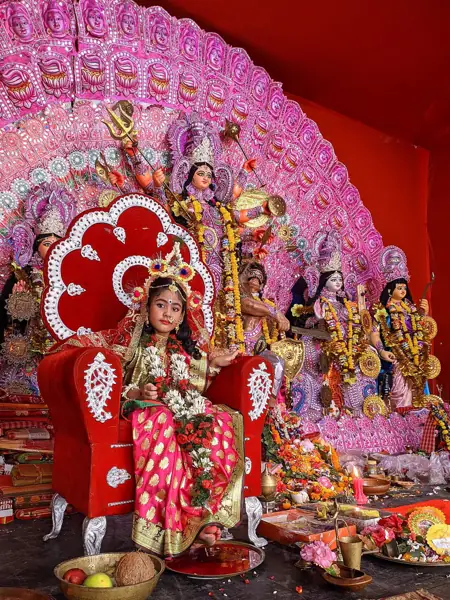
Bengal has its own form of this idea: Kumari Puja, performed on Maha Ashtami. There, a priest worships a single young girl as the Goddess with full ritual, often at Belur Math and at some traditional family pujas. The girl is dressed in red, adorned and seated before the deity, and devotees come to see her.
The two practices share a belief and differ in form: Kumari Puja is a formal temple or pandal ritual for one girl, while kanya pujan is a home ritual for several children with a shared meal. Read about the other rituals of Bengal's eighth day on our Maha Ashtami page.
Variations you may see
- Day: families who follow Ashtami as their main day hold it then; others wait for Navami, sometimes after a havan (fire offering).
- Number: some invite nine girls, others an odd number, others every girl in the lane who comes by.
- Food: puri, chana and halwa is the north Indian classic; some homes add kheer, coconut or sabzi, and in some regions the meal is entirely different.
- Who performs it: often the women of the house lead it, but the whole family usually takes part, washing feet and serving food together.
- If you can't host: some families donate food, books or clothes to girls in need, or contribute to a temple or community kanjak, in the same spirit.
None of these is more correct than another. If your family has a custom, follow it; if you are starting fresh, keep it simple, warm and respectful of the children and their parents.
Tips for a happy kanjak
- Keep the timing predictable; children may be visiting several homes.
- Use a gentle, warm-water wash in cooler weather.
- Keep the portions small; many children will eat at more than one home.
- Smile, be patient and let the children enjoy it. The ritual is about honour, not formality.
Questions people ask
On which day is kanya pujan done, Ashtami or Navami?
Both are common; families follow their own tradition. In 2026, per the Bengal calendar, Ashtami is Monday 19 October and Navami is Tuesday 20 October, but check your local panchang as north Indian dates can differ by a day.
How many girls are invited for kanya pujan?
Nine girls, for the nine forms of the Goddess, is the ideal many families aim for, but any number invited with sincerity is accepted. Many also invite one boy as langur or Bhairav.
What age should girls be for kanya pujan?
Girls are commonly between about 2 and 10 years old, before puberty. Families interpret this differently, and the spirit of the ritual matters more than an exact age.
Why is a boy (langur) included in kanjak?
The boy is commonly seen as Bhairav, the guardian of the Goddess, or in some families as Hanuman (langur). His presence is a custom in many north Indian homes, not a requirement everywhere.
What gifts are given in kanya pujan?
Common gifts are coins or money, bangles, a red chunri, fruit, hair clips, stationery or small toys. Choose something useful and safe for the children's ages.
How is kanya pujan related to Kumari Puja?
Both honour a young girl as a living form of the Goddess. Kumari Puja in Bengal is a formal priest-led ritual for one girl on Ashtami, while kanya pujan is a household ritual for several children with a meal.
Read next
- NavratriNavratri 2026What Navratri means, when Sharad Navratri 2026 falls, its rituals (ghatasthapana, Navadurga, fasting, garba) and how it differs from Bengal's Durga Puja.
 RitualsKumari PujaKumari Puja is the Durga Puja rite in which a young girl is worshipped as the goddess, best known at Belur Math on Maha Ashtami. Its meaning, history and steps.
 NavratriNavratri fasting rulesNavratri vrat explained: types of fast, foods commonly allowed (kuttu, singhara, sabudana, sama rice) and avoided, a sample day's meals and health cautions.
 NavratriNavadurgaThe nine forms of Durga, from Shailaputri to Siddhidatri: what each name means, how each is depicted and the offering commonly linked to each Navratri day.
 RitualsMaha AshtamiMaha Ashtami 2026 is Monday 19 October: the morning pushpanjali, Kumari Puja, Sandhi Puja with 108 lotuses and lamps, fasting until anjali and what people wear.