Kumari Puja: the goddess in a young girl
 Pujo Parikrama team3 min read · Updated
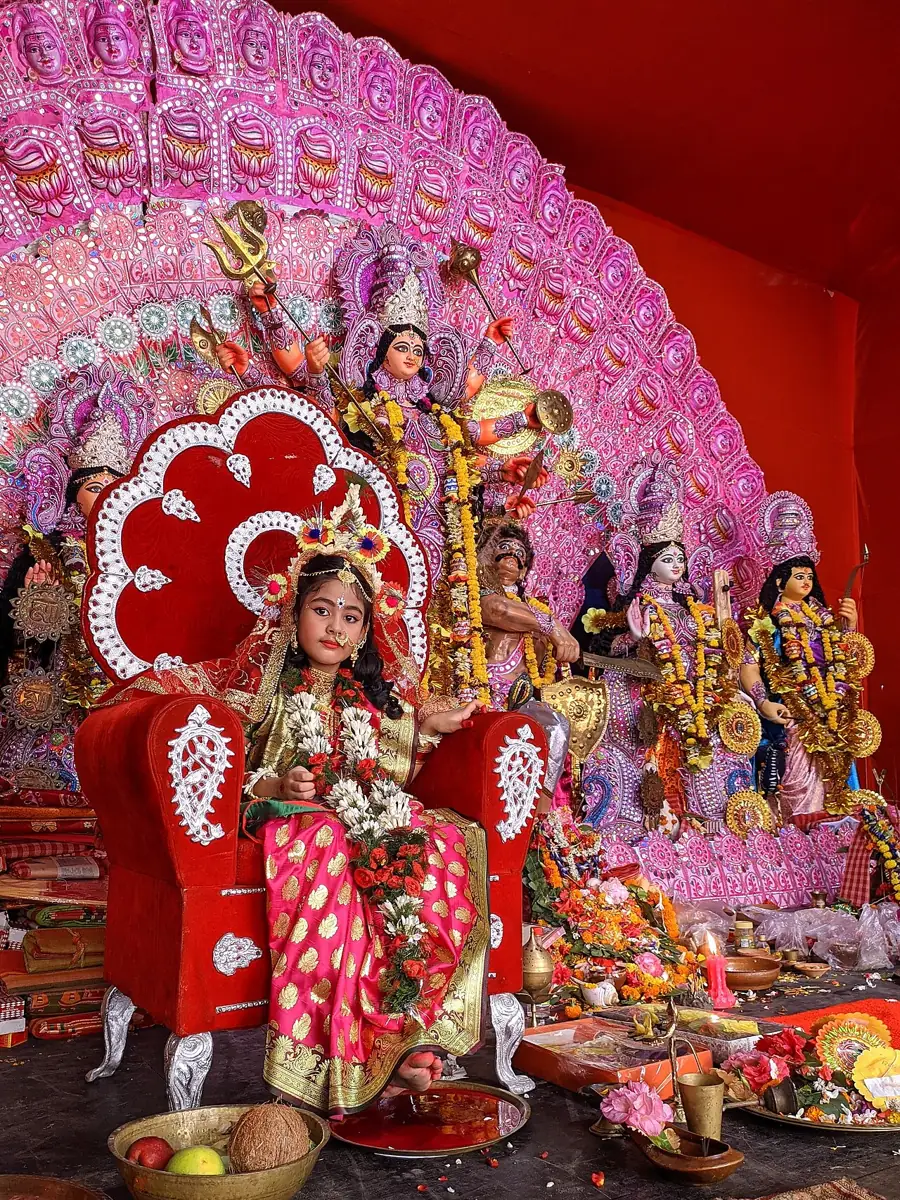
Kumari Puja is the worship of a young girl, usually before puberty, as a living form of the goddess Durga. In Bengal it is held during Durga Puja, most often on Maha Ashtami morning, and the best-known public Kumari Puja is at Belur Math near Kolkata, where Swami Vivekananda is widely credited with reviving it in 1901. In 2026 Maha Ashtami falls on Monday 19 October.
 ▶ Photo story · 7 pagesKumari Puja: the goddess in a young girl
In this article 5 sections
Kumari Puja (kumari, maiden) is the worship of a young girl as a living form of the goddess. During Durga Puja in Bengal it is most often held on the morning of Maha Ashtami, which in 2026 falls on Monday 19 October. The best-known public Kumari Puja is at Belur Math, the headquarters of the Ramakrishna Math and Mission on the Hooghly opposite Kolkata.
The idea behind it
Shakta tradition teaches that the goddess is present in every woman, and that she can be worshipped in a girl as purely as in an image. The young girl, before puberty, stands for the goddess's innocence and creative power in its unformed, potential state. Worshipping her is meant to teach devotees to see the divine in every woman, and to honour girls and women in everyday life.
Tantric and Puranic texts describe Kumari Puja, and some give the goddess a different name for each age of the girl. Practice varies, and not every Durga Puja includes it.
What happens
Details differ by tradition, but the sequence usually looks like this:
- The chosen girl is bathed and dressed in a red sari, with flowers, ornaments and sometimes a crown.
- Her feet are washed and decorated with alta (red dye), and she is seated on a decorated seat near the deity.
- The priest worships her as the goddess, with the same mantras and offerings used for Durga: flowers, bel leaves, lamps, incense, fruit, sweets and cooked food.
- Devotees, including monks and priests, bow before her.
The girl is treated as the goddess for the duration of the ritual, and families often describe it as a moment of great honour.
 Also readMaha Ashtami
Belur Math and Swami Vivekananda
Kumari Puja was practised in Bengal long before modern times, but its best-known public form today is at Belur Math. Swami Vivekananda is widely credited with holding the first Durga Puja at Belur Math in 1901 and worshipping young girls as the goddess there, reflecting the teaching of his guru Sri Ramakrishna, who worshipped his wife Sri Sarada Devi as the goddess. The Ramakrishna Math has continued the tradition, and on Ashtami morning large crowds gather at Belur Math to see it. Check the Math's own announcements for that year's arrangements.
Some other temples and community pujas in Bengal, and in other parts of India, also hold Kumari Puja.
Kumari Puja and kanya pujan
In much of North and West India, families mark Ashtami or Navami of Navratri with kanya pujan, inviting several young girls home, washing their feet and serving them food and gifts. Both share the same idea, the goddess present in a girl, but Kumari Puja in Bengal is usually a fuller temple or pandal ritual centred on one girl.
Visiting
- Belur Math is across the river from North Kolkata and is crowded on Ashtami morning; go early and follow the volunteers' instructions.
- Photography rules differ; ask before taking pictures of the Kumari.
- Combine it with the Ashtami pushpanjali, and read about Maha Ashtami and the goddess Durga.
For the full sequence of the festival, see Durga Puja rituals day by day.
Questions people ask
What is Kumari Puja?
It is the ritual worship of a young unmarried girl as the goddess. She is bathed, dressed in a red sari and ornaments, seated in front of the deity and worshipped with flowers, lamps, incense and food, as the goddess herself would be.
When is Kumari Puja in 2026?
Most Bengali pujas that perform it, including Belur Math, hold it on Maha Ashtami, which in 2026 is Monday 19 October. Some traditions hold it on Navami or on other days; check with the puja or temple.
Who started Kumari Puja at Belur Math?
Swami Vivekananda is widely credited with holding Kumari Puja at Belur Math in 1901, during the first Durga Puja celebrated there, and the Ramakrishna Math has continued the tradition since.
How is the Kumari chosen?
Customs vary. Generally the girl is under the age of puberty, and many pujas choose a girl from a Brahmin family, though some traditions accept girls of any caste or background. Scriptures give names for the goddess at different ages of the girl.
Is Kumari Puja the same as kanya pujan?
They share the idea of honouring girls as the goddess. Kanya pujan, common in North India during Navratri, usually honours several girls with food and gifts at home, while Bengali Kumari Puja is a full ritual worship of one girl, usually in a temple or pandal.
Read next
- RitualsMaha AshtamiMaha Ashtami 2026 is Monday 19 October: the morning pushpanjali, Kumari Puja, Sandhi Puja with 108 lotuses and lamps, fasting until anjali and what people wear.
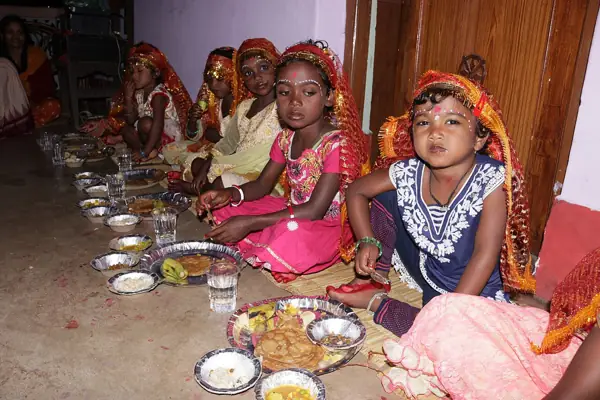 Navratri · 8 stepsKanya pujanHow to do kanya pujan (kanjak) on Navratri Ashtami or Navami: inviting girls, washing feet, tilak, kalawa, the puri, chana and halwa meal, gifts and meaning.
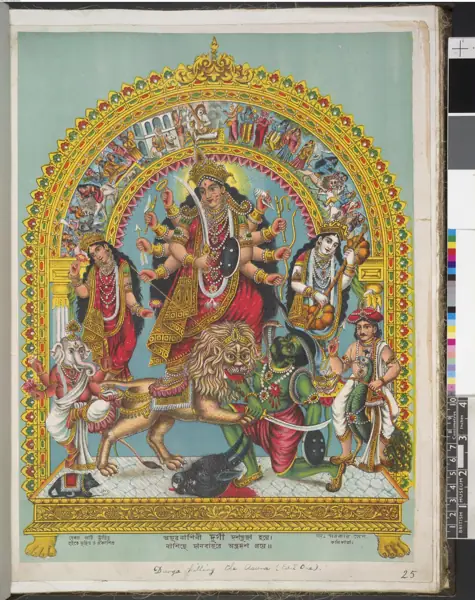 Durga PujaGoddess Durga and her familyHow to read a Durga Puja image: Durga's ten arms and weapons, the lion, Mahishasura, Lakshmi, Saraswati, Ganesha, Kartik, their vahanas, ekchala and daker saaj.
- RitualsDurga Puja rituals day by dayDurga Puja rituals day by day: Mahalaya, Shashthi bodhon, Saptami Kola Bou, Ashtami anjali and Sandhi Puja, Navami homa, Dashami sindoor khela, 2026 dates.